
An end-to-end guide to designing, architecting, and deploying autonomous agentic systems in enterprise environments. This resource covers core architectures, frameworks, business use cases, and strategic deployment practices.
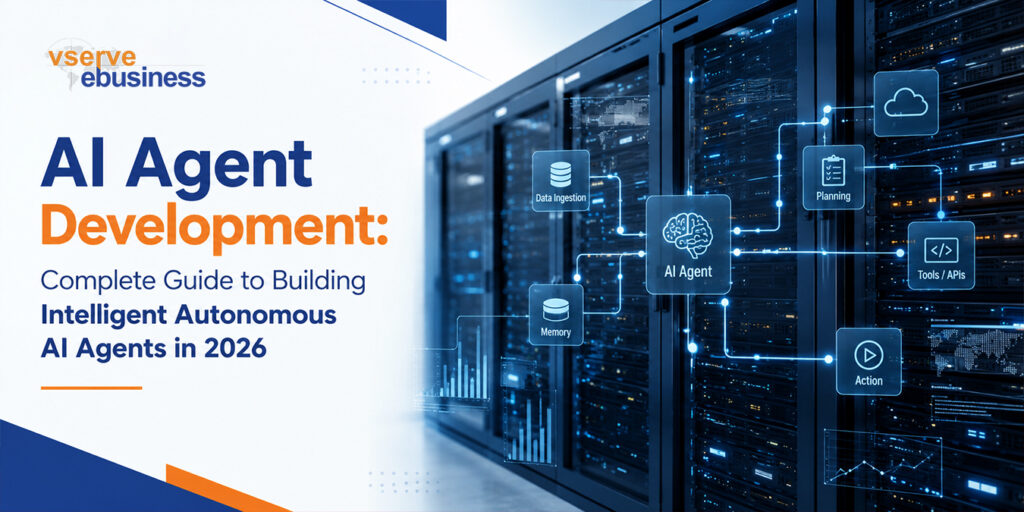
Modern business automation is evolving rapidly beyond rigid rule-based software and traditional conversational assistants. The emergence of AI development enables organizations to build software that operates autonomously to achieve complex business goals.
Unlike static generative tools that require step-by-step human prompts, agentic systems formulate their own plans, call external APIs, and evaluate their own performance. Partnering with specialized teams for agentic AI development services helps enterprises integrate these intelligent workers directly into existing infrastructure.
According to research from Gartner, 40% of enterprise applications will feature task-specific AI agents by the end of 2026, up from less than 5% in 2025. Organizations that master these autonomous capabilities early are achieving dramatic improvements in operational agility and software efficiency.
This guide provides a comprehensive overview of agentic architecture, technical frameworks, and operational lifecycles. Readers will gain actionable engineering patterns to design, test, and scale autonomous systems safely across enterprise environments.
Unlike static generative tools that require step-by-step human prompts, agentic systems formulate their own plans, call external APIs, and evaluate their own performance. Partnering with specialized teams for agentic AI development services helps enterprises integrate these intelligent workers directly into existing infrastructure.
According to research from Gartner, 40% of enterprise applications will feature task-specific AI agents by the end of 2026, up from less than 5% in 2025. Organizations that master these autonomous capabilities early are achieving dramatic improvements in operational agility and software efficiency.
This guide provides a comprehensive overview of agentic architecture, technical frameworks, and operational lifecycles. Readers will gain actionable engineering patterns to design, test, and scale autonomous systems safely across enterprise environments.
We've moved past the era of static AI models. The future belongs to autonomous AI systems, and success will be defined not by prompt engineering, but by how well organizations orchestrate intelligence across their business.
CTO, Fortune 500 Enterprise Software Company
CTO, Fortune 500 Enterprise Software Company
What Is AI Agent Development?
Understanding agentic software begins by defining how autonomous digital entities differ from traditional software applications. Modern AI agent development focuses on creating systems capable of independent perception, reasoning, decision-making, and execution.
While standard chatbots merely generate text responses based on immediate user prompts, intelligent agents maintain state and pursue multi-step goals. They leverage large language models as cognitive engines to interact with databases, web browsers, and enterprise APIs dynamically.
By investing in specialized AI agent development services, businesses can transition from manual task handling to fully autonomous digital operations. These software agents reduce administrative friction, increase operational velocity, and unlock scalability across business functions.
While standard chatbots merely generate text responses based on immediate user prompts, intelligent agents maintain state and pursue multi-step goals. They leverage large language models as cognitive engines to interact with databases, web browsers, and enterprise APIs dynamically.
By investing in specialized AI agent development services, businesses can transition from manual task handling to fully autonomous digital operations. These software agents reduce administrative friction, increase operational velocity, and unlock scalability across business functions.
How AI Agents Work
- Perception: Ingesting unstructured data from environment sensors, user inputs, database triggers, and API payloads.
- Planning: Breaking broad objectives down into structured sub-tasks, execution steps, and priority sequences.
- Reasoning: Evaluating contextual knowledge, assessing risk parameters, and selecting optimal pathways using underlying language models.
- Tool use: Invoking external software tools, executing database queries, and calling third-party REST APIs to retrieve or send information.
- Memory: Retaining short-term conversation context alongside long-term semantic knowledge through vector index stores.
- Action: Performing physical or digital operations across connected enterprise systems to achieve defined objectives.
- Feedback loops: Assessing task execution results, identifying errors, and adjusting future action steps dynamically.
AI Agent Architecture
Building production-grade autonomous systems requires a robust, multi-layered software architecture capable of handling non-deterministic behavior. Each architectural layer plays a specific role in maintaining stability, security, and context awareness.
- LLM layer: Serving as the central cognitive engine responsible for language understanding, intent classification, and reasoning logic.
- Memory: Storing working session states, user preferences, and historical execution logs across short-term and persistent memory stores.
- Tool layer: Housing structured APIs, web scraping utilities, custom Python scripts, and database connectors available for agent execution.
- Orchestrator: Managing execution state graphs, conditional routing, error recovery routines, and multi-agent coordination frameworks.
- Vector database: Providing semantic retrieval-augmented generation capabilities to query proprietary corporate knowledge bases efficiently.
- APIs: Connecting the central agent framework with external software, enterprise resource planning suites, and operational dashboards.
- Monitoring: Tracking token usage, latency metrics, execution trajectories, and cost parameters in real time.
Types of AI Agents
Different operational problems require distinct agent archetypes based on system autonomy, complexity, and environment dynamics. Developers select agent types based on task requirements and environment unpredictability.
- Reactive: Simple agents that respond directly to immediate environment inputs without storing historical state context.
- Goal-based: Purpose-driven agents that evaluate multiple sequential action steps specifically chosen to achieve defined business goals.
- Utility-based: Advanced agents that calculate trade-off scores across different outcomes to choose the highest-value execution path.
- Learning agents: Self-improving entities that analyze operational feedback logs to refine decision-making rules over time.
- Multi-agent systems: Networks of specialized agents collaborating, negotiating, and delegating sub-tasks under a supervisor orchestration framework.
AI Agent Development Lifecycle
Engineering autonomous software requires a structured methodology to handle non-deterministic outcomes safely. Following a rigorous lifecycle ensures that custom AI agent development delivers reliable, secure, and performant enterprise applications.
- Goal definition: Establishing clear business objectives, target metrics, operational boundaries, and human escalation criteria.
- Requirements: Documenting required API integrations, compliance constraints, latency limits, and target user interaction channels.
- Framework selection: Choosing appropriate open-source frameworks, orchestration graph libraries, and state management tools.
- Model selection: Evaluating foundation models based on reasoning capabilities, token costs, context window sizes, and inference speed.
- Knowledge integration: Structuring proprietary knowledge stores, vector index schemas, and retrieval-augmented generation pipelines.
- Development: Coding custom tools, state graph nodes, prompt structures, and multi-agent delegation frameworks.
- Testing: Executing trajectory testing, edge case simulations, security red-teaming, and evaluation benchmark suites.
- Deployment: Containerizing agent applications and releasing them onto scalable cloud infrastructure with robust API gateways.
- Monitoring: Observing live trajectory traces, hallucination rates, tool failure rates, and token consumption metrics continuously.
- Continuous improvement: Refining prompt templates, tool descriptions, and fine-tuning base models based on real-world execution traces.
Popular AI Agent Frameworks
Selecting the right development framework accelerates engineering velocity while providing essential state management abstractions. Organizations seeking custom AI agent development services evaluate frameworks based on community support, ecosystem maturity, and graph control.
Open-Source Framework Overview
- Modern open-source libraries simplify multi-agent orchestration, tool integration, and state persistence. Developers select frameworks based on control granularity and multi-agent orchestration requirements.
- LangGraph: A low-level framework built by LangChain that models agent workflows as cyclical state graphs with fine-grained control.
- CrewAI: A high-level, role-playing framework designed for setting up collaborative multi-agent teams quickly and intuitively.
- AutoGen: An open-source framework from Microsoft focused on multi-agent conversation abstraction and complex task orchestration.
- BeeAI: An open-source framework developed by IBM designed for building and deploying enterprise-ready agent applications securely.
- Semantic Kernel: Microsoft enterprise SDK that integrates language models with conventional programming languages seamlessly.
- OpenAI Agents SDK: A streamlined library tailored for orchestrating lightweight tool calling, assistant threads, and multi-agent handoffs.
Common Business Use Cases
Enterprise organizations are deploying intelligent agents across core functional departments to automate multi-step operational workflows. Investing in professional AI agent development allows enterprises to unlock substantial efficiency gains across business functions.
- Customer support: Autonomous agents handle complex order modifications, issue troubleshooting, and return authorizations end-to-end.
- Sales: Inbound qualification agents research prospective accounts, enrich lead profiles, and schedule discovery meetings automatically.
- HR: Onboarding agents guide new employees through paperwork completion, hardware requests, and policy training modules.
- IT operations: Automated triage agents monitor system logs, resolve routine permission tickets, and coordinate incident escalation paths.
- Finance: Automated auditing agents verify supplier invoices, reconcile expense receipts, and detect anomalous accounting transactions.
- Healthcare: Clinical administrative agents schedule patient appointments, verify insurance coverage, and transcribe intake notes efficiently.
- Manufacturing: Predictive maintenance agents analyze machinery sensor streams and schedule repair jobs before equipment failures occur.
- Supply chain: Autonomous logistics agents re-route delayed shipments, audit freight bills, and coordinate warehouse inventory reordering.
Challenges in AI Agent Development
Deploying autonomous agents into production environments presents unique technical and operational hurdles that require active mitigation. Organizations must address these systemic risks to ensure safe, scalable, and cost-effective operations.
- Hallucinations: Language models may generate plausible but incorrect facts or output invalid tool arguments during task execution.
- Security: Unvalidated agent inputs create vulnerability to prompt injection attacks, unauthorized tool execution, and data leaks.
- Compliance: Ensuring autonomous actions adhere strictly to global data privacy laws, industry regulations, and internal policies.
- Reliability: Managing non-deterministic model behavior to guarantee consistent execution paths across complex multi-step workflows.
- Latency: Accumulated model inference times and sequential API calls can lead to slow user response times.
- Cost: High token consumption across multi-turn reasoning loops can rapidly inflate cloud inference expenses if left unmonitored.
- Scalability: Maintaining persistent state management and execution speed when scaling from dozens to thousands of active agents.
Best Practices
Building reliable enterprise agent systems requires applying disciplined software engineering principles and governance standards. Engaging experienced teams for AI agent development services helps organizations establish secure, production-ready operational environments.
- Human-in-the-loop: Implementing mandatory human approval checkpoints for high-risk actions, financial transactions, and external communications.
- Observability: Implementing comprehensive telemetry logging to record complete execution traces, token costs, and tool call payloads.
- Testing: Establishing automated evaluation benchmarks using deterministic test cases and language-model-based trajectory judges.
- Prompt engineering: Writing clear, constrained system prompts that define agent boundaries, output schemas, and fallback procedures.
- Security controls: Enforcing strict principle-of-least-privilege access permissions for all external tools and database connectors.
- Governance: Setting clear operational boundaries, fallback mechanisms, and audit logs to ensure transparent system accountability.
Frequently asked questions
What is AI agent development?
Modern AI agent development is the process of engineering software applications that use language models to reason, plan, and execute tasks autonomously. These systems combine context memory, reasoning engines, and external API tool integrations to achieve complex business goals.
How long does it take to build an AI agent?
Building a simple single-agent proof-of-concept typically takes two to four weeks using modern open-source frameworks. Deploying a fully integrated, enterprise-grade multi-agent system with security controls usually requires three to six months.
Which frameworks are best?
The best framework depends on your specific architectural requirements, control preferences, and internal team expertise. LangGraph is ideal for granular state graph control, while CrewAI and AutoGen excel at rapid multi-agent team setups.
How much does AI agent development cost?
Initial pilot development ranges from 15,000 to 50,000 dollars, depending on system complexity and tool integrations. Full enterprise deployment can range from 75,000 to over 250,000 dollars, factoring in cloud infrastructure and ongoing MLOps maintenance.
Can AI agents work without human supervision?
AI agents can operate fully autonomously for low-risk, deterministic tasks with well-defined operational guardrails. However, enterprise systems typically implement human-in-the-loop controls for high-stakes decisions, financial approvals, or sensitive communications.
What industries benefit most?
Industries with high data volume and complex operational workflows benefit most, including software, financial services, healthcare, supply chain, and retail. These sectors leverage autonomous agents to streamline customer service, logistics, and data processing.
How do AI agents differ from chatbots?
Chatbots rely on simple text generation and user-prompted responses without maintaining dynamic goal-oriented execution states. AI agents independently plan sub-tasks, call external APIs, evaluate task outcomes, and complete complex workflows autonomously.
What skills are needed to develop AI agents?
Developing production agents requires expertise in Python, language model APIs, vector databases, API design, and asynchronous software engineering. Knowledge of MLOps, state management, observability tools, and security guardrails is also essential.
What are the biggest challenges in AI agent development?
The biggest challenges in AI agent development involve ensuring reliability, maintaining data security, controlling operational costs, and preventing inaccurate outputs. Organizations must also address memory management, tool orchestration, monitoring, and governance to achieve consistent performance in production environments.
How do businesses measure the success of AI agents?
Businesses typically measure AI agent performance using metrics such as task completion rates, response accuracy, processing time, operational cost savings, and customer satisfaction scores. Long-term success is often determined by the agent’s ability to scale efficiently while maintaining reliability and reducing manual effort.
ON THIS PAGES
Get Expert Help
Talk to our team about your AI or process automation needs.